Source: White House / USTR / U.S. Treasury / China Ministry of Commerce / Reuters / Associated Press (AP)
See the prediction scoreboard →
No, not on the evidence so far.
“New Yalta” is a fear about who sat at the table, not a finding about what got signed. The Shenzhen declaration carves up nothing, and the one hard deadline in this story is the US-China trade truce, which expires Jan 10.
I think that deadline ends in an extension or a replacement deal, and I’d put it at 70%.
Look at the choreography, too.
NPR reported that Trump’s talks with Putin lasted 42 minutes, his talks with Xi about an hour, and the three-way session an hour and a half (AP and CNN clocked it nearer 70 and 81 minutes). He then left without speaking to reporters. NPR suggested the summit’s main achievement may have been the photograph itself. I’d push that idea further: when the headline result of a summit is a photo, what the summit really produces is the argument about what that photo means.
That argument is the “Yalta 2.0” label, which Euronews says media commentators coined.
By Nov 19 in Berlin, Merz was saying a Yalta-style format won’t bring peace and calling Shenzhen “apparently a photo opportunity” (Anadolu, Reuters). Putin said Russia had proposed that European leaders come to Moscow, and he says he won’t allow a Europe-led peacekeeping force in Ukraine (RFE/RL, Euronews).
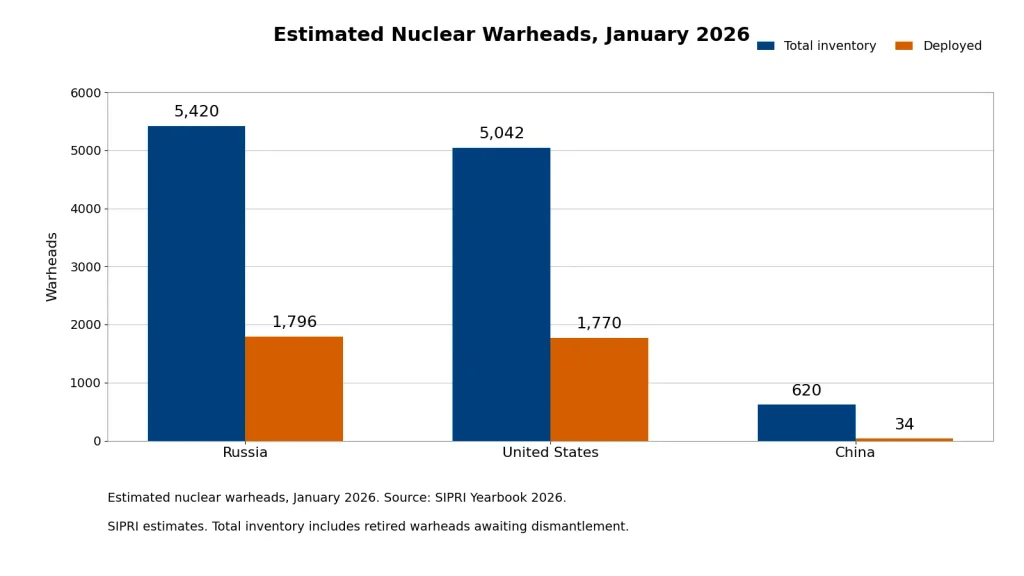
Now the line about nuclear war, which is the one with teeth. New START expired on Feb 5, 2026, so for the first time since 1972 the US and Russia have no binding ceiling and no inspections (The Week). SIPRI’s January 2026 estimates put Russia at about 5,420 warheads, the US at 5,042 and China at 620.
China has refused trilateral talks before, citing that gap (Al Jazeera, Nov 16). Responsible Statecraft noted the declaration names no concrete next steps.
Three leaders reaffirmed that nuclear war can’t be won and pledged a dialogue, but nothing yet makes one harder to stumble into.
Two old photographs
Yalta ran Feb 4–11, 1945, in Crimea, with Roosevelt, Churchill and Stalin (State Department).
The fight was over Poland, and underneath it, whether great powers get spheres of influence or small nations get a say (FDR Library).
Roosevelt was seriously ill and died two months later, and many Americans later blamed him for conceding too much to Moscow.
Yet the Foreign Office’s own historian calls the idea that Yalta “carved up” Europe an enduring myth, and scholars still fight about it. If the original is contested, a “Yalta 2.0” label for a four-point declaration is a stretch.
The better parallel is Nixon in China, Feb 21–28, 1972, the first visit by a sitting US president (State Department).
The Shanghai Communiqué was signed the evening of Feb 27 and dated Feb 28 (Wilson Center). It didn’t bring full diplomatic relations, which only came in 1979. What it brought was leverage over the Soviet Union.
And here’s where the analogy breaks, and it’s the best reason to worry.
In 1972, Washington courted the weaker of two rivals to gain leverage over the stronger one. In 2026, AP reports the Xi-Putin relationship as stronger than either leader’s tie to Trump. That doesn’t mean spheres of influence were agreed. It means the leverage Nixon built may not be available this time, and a symbolic, non-binding declaration is exactly what you’d sign when no one has leverage to spend.
Treat “new Yalta” as a test, then: the text fails it, and the power balance leaves it unsettled.
The deadline that is real
The truce is where something can actually break, and nothing in Shenzhen touched it. I found no reported trade deal or tariff cut from the Trump-Xi meeting as of Nov 23. Xinhua said Xi warned against “turbulence” over Taiwan and urged cooperation on AI, and Reuters noted the talks came amid growing tension over reports of Nvidia chips being diverted to China.
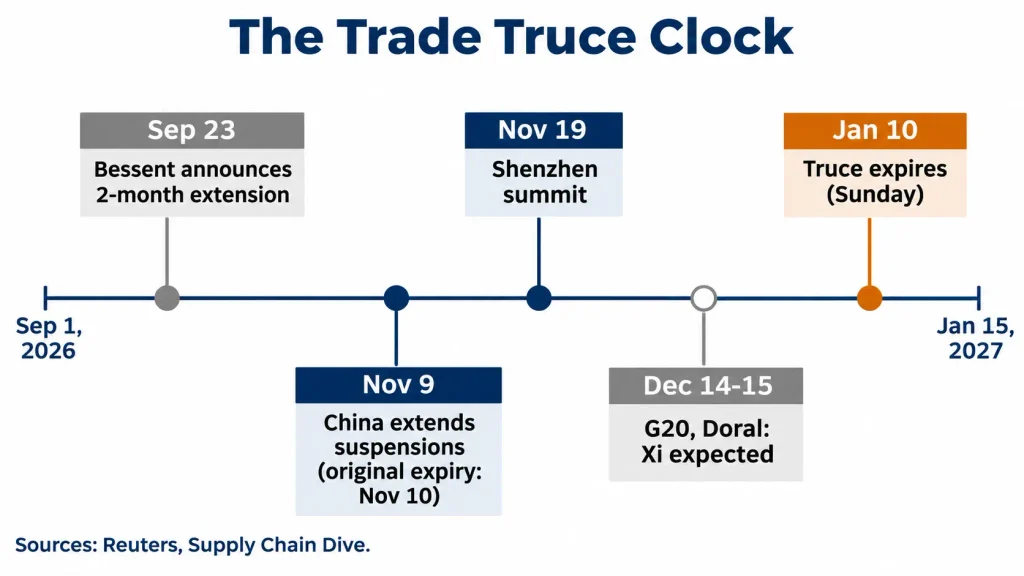
The state of play: China said on Nov 9 that it was keeping its suspensions in place until Jan 10, 2027, per Reuters via TimesLive. Those cover measures against 11 US firms on its unreliable-entities list, 16 on its export-control list, and special port fees on US-linked vessels. Bessent said back on Sept 23, via Supply Chain Dive, that the truce’s conditions stay in effect until Jan 10 and he wasn’t sure whether a “bigger deal” would land by then or the truce would simply be extended.
Two things push me toward extension.
First, Trump and Xi are expected to meet again this year, at the G20 at Doral in Florida on Dec 14–15 (Reuters), which gives both sides a natural moment to announce something. Second, neither side has shown any appetite for the cliff. Both have been rolling the truce forward, and rolling it forward again is the cheapest move.
My one caveat is that the Shenzhen declaration is symbolic and non-binding, so don’t read it as either a carve-up or a breakthrough.
Everything else I’m committing to.
By Jan 10, 2027, the US or Chinese government will officially announce an extension of the current truce’s suspensions beyond Jan 10, or a new agreement replacing it.
Reports that “talks continue” don’t count.
A statement from the White House, USTR, Treasury or China’s commerce ministry, or Reuters or AP reporting one, settles it on Jan 10, 2027.
I’d put it at about 70%, and I’ll score it on the scoreboard that day.