Voters are choosing whether to allow data centers because if AI ends up needing more power than expected, someone has to pay the extra cost and no one wants that cost to fall on them. Data centers didn’t double your bill.
They pull a lot of power in a few places, but nationally, their impact is tiny. I think the stricter rules will pass in more than half of the November 3rd votes.
What’s actually on the Ballot
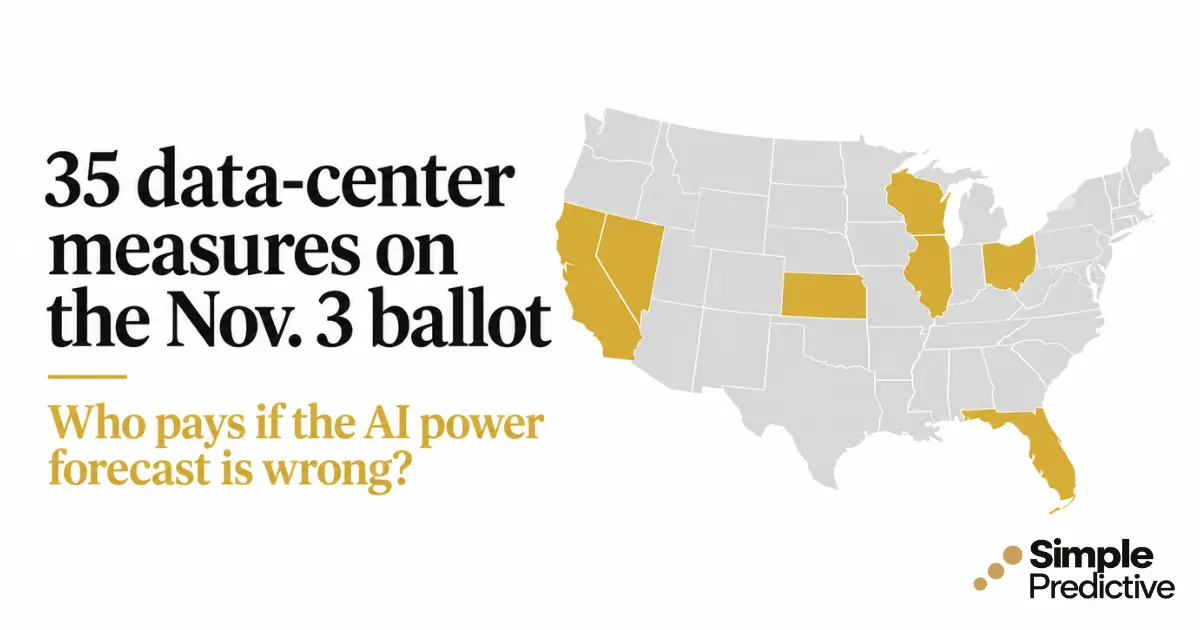
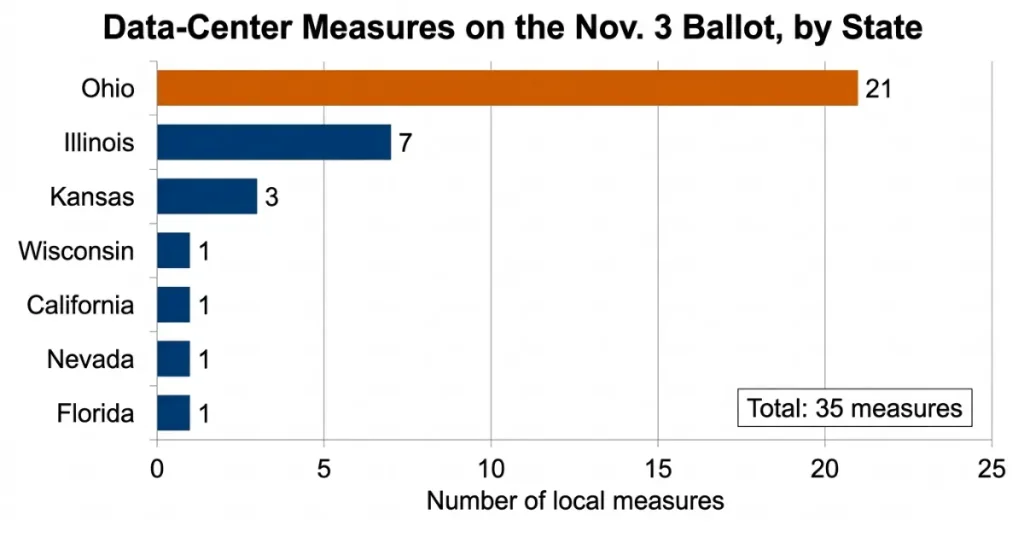
According to Newsweek and S&P Global, there are about 35 local votes on data centers coming up on November 3rd. Notably, the four measures already decided earlier this year all passed with stricter limits.
This isn’t a single yes-or-no vote on data centers, but a mix of different local issues. For instance, Illinois has seven measures some push for projects while others want freezes, and a few are just advisory. Elsewhere, Alhambra, California, is voting on a total ban, while Janesville, Wisconsin, wants voters to approve any massive project over $450 million.
This shift to local votes is happening because Washington punted. A Senate bill addressing data center energy costs failed 57–43 on September 30, falling short of the 60 votes required, and Congress is out for October. Meanwhile, S&P Global reported over 50 canceled projects this year, local bans or freezes are active in 40 states, and a Texas Politics Project poll shows 57% of Texas voters oppose data centers in their own neighborhoods. Public opinion isn’t waiting around for Congress.
What your Bill actually says
Let’s look at the electricity side. The best proof comes from PJM, the grid operator for parts of the Mid-Atlantic and Midwest. They hold a yearly auction where power plants are paid ahead of time to guarantee they will be available. You can think of it like a retainer fee for power.
The July 14 auction, covering June 2028 through May 2029, totaled $16.4 billion, per Industrial Info. The market experts attributes about $6.3 billion of that to data centers. Regulators had already capped prices after 2024’s 833% jump, and PJM’s own report shows the auction still missed its reliability target for a second straight auction, and would have cleared at $554.72 per megawatt-day without the $325 cap. Here’s the kicker: Canary Media found only 525 megawatts of the 138.3 gigawatts that cleared was new capacity. Everyone’s paying more, and almost nothing new is getting built.
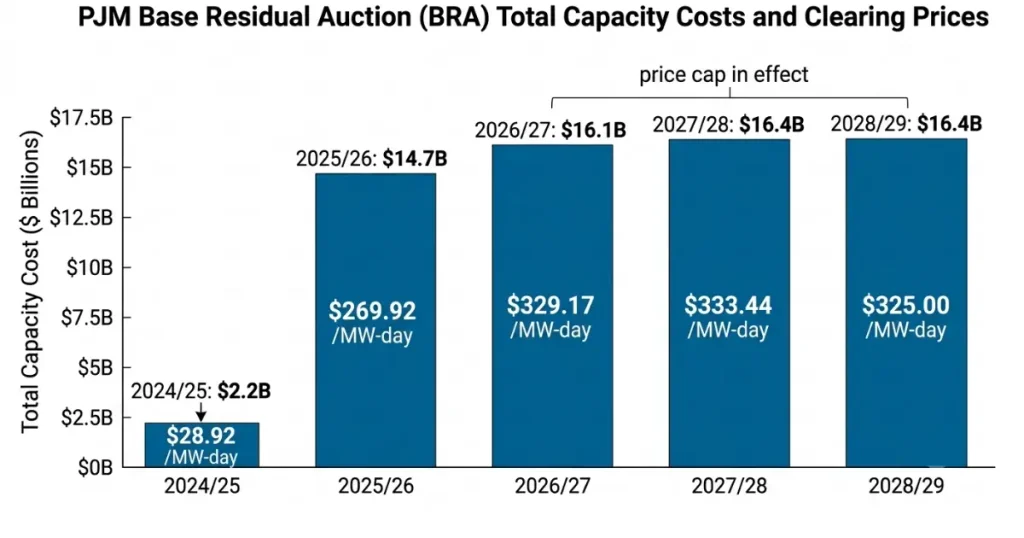
(Capacity accreditation rules changed starting in 2025/26.)
The first half of 2026 shows the exact same problem. Wholesale power costs jumped over 50% to 114.50 dollars per megawatt-hour, and capacity costs tripled. Projected data center demand alone accounted for nearly 10% of that total. While the market itself is fair and nobody is cheating the system, the real pressure comes from high demand hitting a very slow supply.
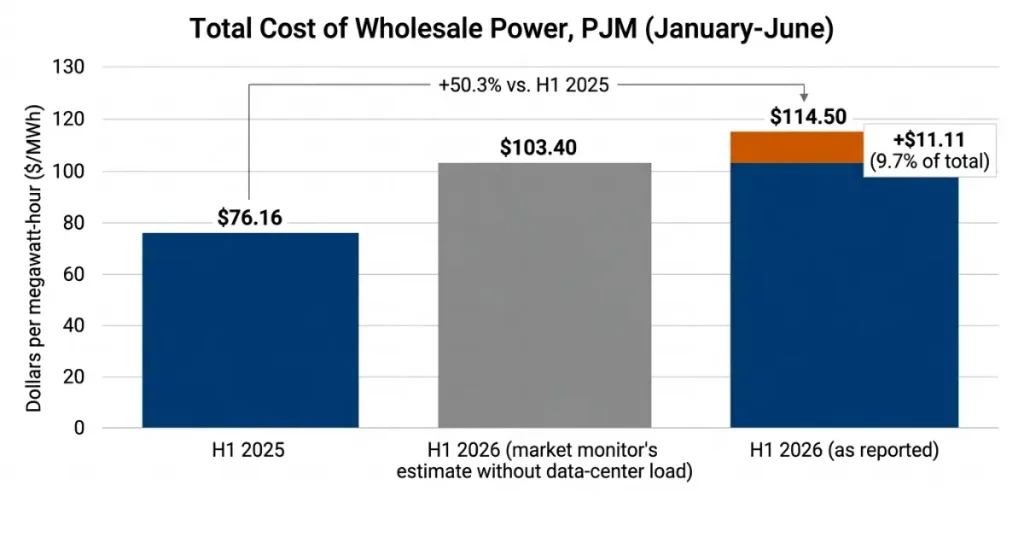
(PJM’s independent market monitor)
The $103.40 bar is the market monitor’s estimate of what costs would have been without data-center load in the capacity market, not an observed price. 9.7% is $11.11 as a share of $114.50.
Here is where we need to slow down. Data centers drive up power prices, but they are not the only cause. Experts tie about 38% of that auction’s cost to them, but capacity is just one part of your bill. Things like natural gas prices, weather, and power lines also drive up costs. Plus, many places holding votes are not even connected to that specific grid. Government data shows the average US home electricity rate will rise about 5% in 2026, followed by a 3% increase next year. If someone tells you a data center doubled your bill, they are lying.
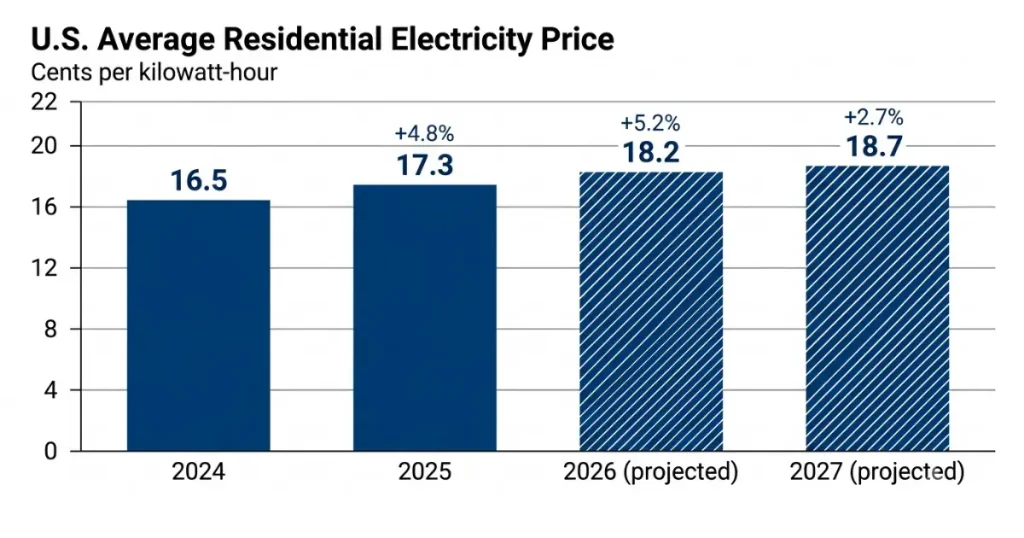
(Percent changes calculated from the rounded figures shown)
The 1983 Warning
Voters do not need a perfect math model to get angry. They just need to remember who got stuck with the bill last time.
Back in 1983, a Washington State power agency nicknamed “Whoops” defaulted on 2.25 billion dollars in bonds for two unfinished nuclear plants, marking the largest municipal default in US history at the time. Slow demand growth had ruined their energy forecasts, but utilities had already signed contracts guaranteeing repayment even if the plants were never completed. The cost estimate for the project had ballooned from 4.1 billion dollars to 24 billion dollars. Eventually, the state Supreme Court ruled that dozens of utilities did not have to pay the debt. That historical mess highlights the exact question on this year’s ballots: when future forecasts are just a gamble, who signs the guarantee?
California in 2000 and 2001 is the other half of the story. Wholesale power prices surged about 800% between April and December of 2000, triggering a state of emergency in January 2001. News reports showed this crisis helped spark the 2003 recall of Governor Gray Davis, whom voters removed on October 7 of that year. That situation was caused by market cheating and retail price caps, rather than bad forecasts, so I am focusing on the political fallout rather than how it happened. That backlash is the main point because sudden bill spikes always become political disasters.
The Prediction
Here is the prediction.
The side wanting restrictions will win in over half of the data center votes on November 3rd.
This means most results will limit, ban, or add strict conditions to new projects. I will use Ballotpedia’s list from November 2nd and their unofficial results to settle this on November 10, 2026.
I give this a 70% chance of happening and will check the final score that day.