
Death by meritocracy does not arrive with open violence. It arrives wearing the language of fairness, talent, and open competition. It tells the ambitious young that the highest positions belong to those who prove themselves through measured excellence. Then it subjects them to a process so selective, so psychologically demanding, and so tightly controlled that many of those who succeed emerge diminished, while the system itself grows more closed and more self-protecting.
What presents itself as the neutral discovery of ability functions, in practice, as one of the most effective mechanisms of elite reproduction in the modern world. The damage is not incidental. It is structural.
What Death by Meritocracy Actually Means
Meritocracy claims that social position should reflect individual ability and effort rather than birth or connection. In its idealized form, this sounds uncontroversial. In its institutional form, particularly in the American elite university system, it becomes something else entirely.
Death by meritocracy refers to the process by which a system of extreme selective pressure, credential competition, and status concentration produces three simultaneous outcomes: it legitimizes a narrow elite under the banner of fairness; it imposes heavy psychological costs on those who enter and those who are excluded; and it weakens the broader society’s capacity to develop and recognize talent outside the approved channels.
The system does not merely sort people. It reshapes them. It teaches the ambitious that their worth is contingent on continuous performance within a narrow set of evaluated traits. It converts education into a high-stakes tournament whose winners gain access to networks, capital, and authority, while the majority internalize the sense that they have fallen short of a supposedly objective standard.
This is not the neutral operation of talent. It is a designed environment with predictable human consequences.
The Central Mechanism: Extreme Selection as Control
The central mechanism is extreme, high-stakes selection controlled by a small number of institutions that set the terms of entry into the highest status layers.
Elite universities do not simply identify ability. They define what counts as ability, how it will be measured, and what combination of signals will be rewarded. Standardized testing, carefully curated extracurricular profiles, essays that perform the correct kind of selfhood, and opaque “holistic” review together create a process that is both intensely competitive and difficult to game without deep cultural knowledge of the system itself.
Those who succeed often do so by organizing large parts of their adolescence around the requirements of admission. The process rewards not only cognitive ability but also the capacity to sustain prolonged performance under evaluation, to present a coherent narrative of self, and to navigate an environment whose rules are only partially explicit. The result is a cohort that has already demonstrated high compliance with institutional demands before it ever reaches positions of formal power.
Once inside, the same logic continues. Status within the elite layer remains contingent on further performance within approved institutions and networks. The system does not release its grip after admission. It extends it.
This is how death by meritocracy operates at the mechanical level: it turns the pursuit of excellence into a continuous, high-pressure sorting process that concentrates future power while shaping the psychology of those who pass through it.
The Broader Pattern of Damage and Concentration
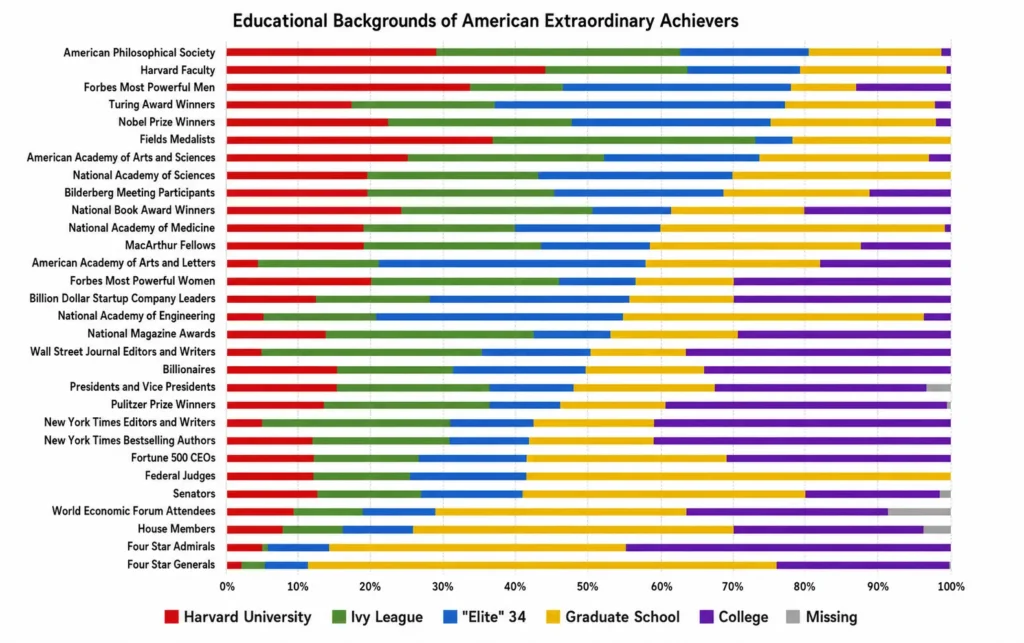
The system produces several reinforcing effects.
It concentrates opportunity. Access to the highest levels of finance, law, government, media, and technology remains heavily mediated by a small number of educational credentials. The language of merit justifies this concentration. Those who hold the credentials can claim they earned them through open competition. Those who lack them are left to explain why they fell short of a standard presented as objective.
It generates widespread psychological strain. For those inside the tournament, the pressure to perform, to curate an acceptable self, and to avoid any signal of weakness is intense. Anxiety, perfectionism, and a brittle relationship to failure become common. For those outside, the same system can produce a sense of permanent exclusion from the highest forms of recognition and opportunity, even when their actual capabilities are high.
It narrows the range of valued human traits. Qualities that are difficult to measure or that do not photograph well in an admissions file—certain forms of practical judgment, independent thinking that resists institutional framing, late-blooming ability, or character formed outside elite environments—are systematically undervalued. The system selects for what it can see and score.
It creates a self-reinforcing elite. Those who pass through the most selective institutions gain access to networks that further amplify their advantages. Their children inherit not only resources but also intimate knowledge of how the selection process works. The language of merit continues to operate, now protecting an increasingly hereditary advantage.
These patterns do not require conspiracy. They emerge from the incentives and design of the system itself. Death by meritocracy is the cumulative human and social cost of that design.
Historical Parallels
The American elite university system did not appear from nowhere. Its deeper logic has earlier expressions.

In imperial China, the examination system offered a formal path into the ruling bureaucracy based on demonstrated mastery of classical texts. In theory it was open. In practice it favored those with the resources, leisure, and cultural training required to prepare for years. The system produced a scholar-official elite that legitimized itself through the language of merit while remaining heavily shaped by family background and prior access to education. It also generated intense pressure and high rates of psychological strain among candidates who invested years of their lives in a process with very low success rates.
In early modern Europe, certain aristocratic and later professional elites maintained systems of education and sponsorship that claimed to reward ability while in reality filtering for cultural compatibility and existing connection. The language of desert and cultivation justified the outcome. The practical effect was the reproduction of a narrow governing layer under the appearance of selection by quality.
In the twentieth-century United States, the transformation of the Ivy League from regional upper-class institutions into national engines of elite selection followed a similar pattern. The introduction of more formalized testing and admissions criteria was presented as a move toward fairness and the discovery of talent regardless of background. Over time the same institutions became the primary gatekeepers to the highest status positions, while the competition for entry intensified to the point of distorting the development of the young people involved. The rhetoric of merit remained. The concentration of power increased.
Across these cases the surface forms differ. The structural result is consistent: a system that claims to reward ability ends up concentrating authority in a narrow, self-reproducing layer while imposing heavy costs on those who compete within it.
Why Death by Meritocracy Persists
The system persists because it solves several problems for those who already hold advantages, while remaining difficult to challenge on its own terms.
It provides legitimacy. In a society that formally rejects hereditary aristocracy, a system that claims to select by talent offers a powerful moral justification for unequal outcomes. Those who succeed can believe, and can tell others, that their position reflects genuine superiority of ability and effort.
It is difficult to oppose without appearing to reject excellence itself. Criticism of the system is easily reframed as resentment or as an attack on standards. This protects it from reform even when its human costs become visible.
It serves the interests of the institutions that control it. Elite universities gain prestige, resources, and influence by maintaining extreme selectivity. The more competitive the process becomes, the more valuable the credential appears.
It aligns with the self-understanding of those who have succeeded within it. Many of the system’s strongest defenders are people whose own identities were formed by succeeding in the tournament. To question the system deeply is, for them, to question the meaning of their own achievement.
These factors make death by meritocracy remarkably stable. The damage it produces is real, yet the language of fairness and the concentration of institutional power protect it from fundamental challenge.
The Path Toward Distorted Elites
When extreme selective pressure becomes the primary route into leadership positions, the character of the elite itself begins to change.
The system favors those who can sustain high performance under continuous evaluation from an early age. It is less effective at identifying those whose strengths emerge later, or whose abilities do not fit the evaluated categories, or who refuse to organize their development around institutional approval. Over time the leadership class becomes narrower in background, more anxious about status, and more tightly bound to the institutions that certified them.
This produces a distinctive form of fragility. An elite selected primarily for success within a high-pressure, highly evaluated environment may be less capable of independent judgment when the environment changes or when the approved metrics no longer capture what is required. The same process that concentrates formal power can thin out the range of human capacity available at the top.
The endpoint is not necessarily open collapse. It is a governing layer that is highly credentialed, tightly networked, psychologically shaped by years of high-stakes evaluation, and increasingly distant from the wider population whose lives it affects. Death by meritocracy names both the cost to the individuals who pass through the system and the longer-term cost to the society that depends on them.

Connecting the Threads
Death by meritocracy connects directly to the earlier patterns of power.
Elite overproduction and the concentration of status competition were already visible in the analysis of how societies collapse. The meritocratic tournament intensifies that competition and channels it through a narrow set of institutions, raising the psychological stakes while limiting the number of recognized winners.
Closed elite networks, examined in the discussion of how evil triumphs, gain a powerful legitimizing mechanism when their members can claim to have been selected by open, objective processes. The language of merit makes the closed nature of the resulting networks harder to see and harder to challenge.
The psychology of evil described how formative environments shape the inner commitments of leaders. The elite university system functions as one of the most important such environments in the contemporary world. It does not need overt programming. The continuous pressure of evaluation, the curation of self, and the high stakes of admission and advancement perform a related function: they shape what kinds of people reach positions of influence and what kinds of selves they inhabit when they arrive.
Understanding how real power works clarifies why control over the definition and certification of merit is itself a major form of power. Those who set the terms of selection shape the future composition of the elite.
Practical Observations
Several signals indicate that a meritocratic system has moved from talent discovery into the territory of death by meritocracy:
- Extreme concentration of future leadership positions among graduates of a very small number of institutions
- Intense, multi-year pressure on adolescents to curate performance and identity for admission
- High levels of anxiety, perfectionism, and status fear among those inside the competitive channel
- Systematic undervaluation of abilities and forms of character that do not fit the evaluated metrics
- Growing hereditary advantage within a system that continues to describe itself as open and fair
Societies that maintain multiple genuine pathways into influence, that refuse to allow a small number of institutions to monopolize the definition of excellence, and that protect the young from totalizing evaluation environments limit the damage. Those that allow the tournament to become the primary route to status pay for it in narrowed elites and widespread psychological cost.
The core insight is structural. Death by meritocracy occurs when the language of fairness and talent is used to operate a high-pressure selection system that concentrates power, distorts human development, and legitimizes the resulting hierarchy as natural. The system does not need to abandon the rhetoric of merit. It only needs to control what counts as merit and who is allowed to certify it. Once that control is secure, the damage becomes self-reinforcing and difficult to reverse.
This article is an original analysis inspired by Professor Jiang’s lecture Secret History #7: Death by Meritocracy. The structure, explanations, and historical examples are independently written. Original lecture: https://www.youtube.com/watch?v=JU_8fJjtGxA