

Settled civilizations keep losing to people they call barbarians.
This is not a rare accident. From the Yamnaya expansions into Europe and South Asia, through successive Iranian, Turkic, and Mongol waves, mobile pastoral societies have repeatedly overrun denser, more hierarchical agricultural systems that possessed writing, monumental architecture, and elaborate bureaucracies. If civilization is defined by openness, innovation, and prosperity, the historical record is awkward. The side with more institutions often loses.
The conventional explanations — superior horsemanship, sudden technological edges, or pure destructiveness — are incomplete. They describe tools, not the underlying competitive system. Steppe societies functioned as a recurring civilizational type: high mobility + high internal cohesion + low institutional rigidity. Under specific ecological and social conditions, that combination outcompeted the denser, more stratified systems of the river valleys. The same type repeatedly lost its edge once it settled and adopted the institutional density of the societies it had conquered.
Conditions
The Eurasian steppe is a hard environment for dense sedentary life. Rainfall is unreliable, soils are often thin, and large-scale irrigation is difficult. Pastoralism — herding sheep, cattle, horses — became the dominant adaptation. Mobility was not a lifestyle choice; it was a survival requirement. Groups that could move herds to seasonal pastures survived. Groups that could not, did not.
This ecology selected for certain social traits. Decision-making had to remain relatively fluid. Rigid hereditary hierarchies and heavy administrative layers slowed movement and response. Cohesion came less from formal institutions than from kinship, shared ritual, and the practical necessity of mutual defense. Leadership tended to be performance-based: a leader who failed in war or in managing herds lost followers.

David Anthony’s work on the horse, the wheel, and the spread of Indo-European languages documents the material side of this system. Domestication of the horse, development of wheeled vehicles, and the resulting increase in range and speed gave steppe groups a decisive operational advantage. Linguistic and genetic evidence links major expansions — particularly the Yamnaya horizon — to the movement of these pastoral populations into Europe and parts of Asia.
Marija Gimbutas framed the impact on “Old Europe” as the arrival of a more patriarchal, hierarchical, and war-oriented culture that disrupted earlier, more egalitarian farming societies. Parts of her reconstruction remain contested. The genetic data showing substantial male-line replacement in some regions is stronger than the full cultural package she described. The core demographic and mobility facts, however, are no longer seriously disputed.
Mechanism
The competitive advantage was systemic, not merely technological.
Mobility allowed steppe groups to concentrate force rapidly, strike, and withdraw before settled armies could fully mobilize. Low institutional rigidity meant that successful war leaders could assemble coalitions quickly and discard failed ones. High cohesion — rooted in shared pastoral life and often in a mythology that celebrated conquest and the warrior — reduced the free-rider problem that plagues larger, more anonymous agricultural populations.
Settled civilizations developed the opposite profile over time. Early city-states could be innovative and competitive. As they scaled into empires, bureaucracy, hereditary elites, and temple or palace redistribution systems thickened. Decision-making slowed. Internal extraction increased. The same Mandate logic examined in the previous article — hierarchy justified as cosmic order — locked people into place but also reduced exit options and adaptive speed. When external pressure arrived from a more fluid system, the denser society often proved brittle.
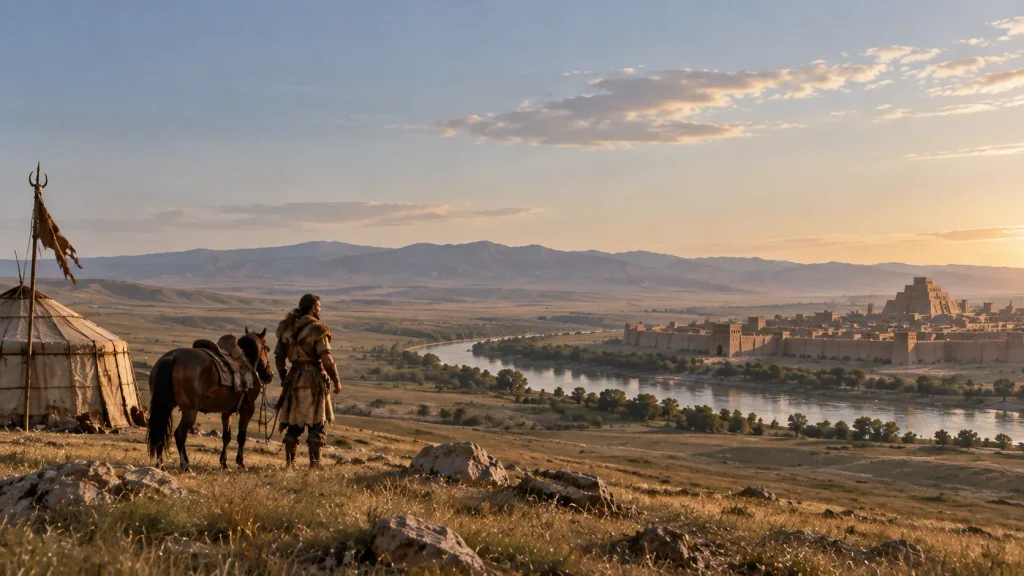
This is not a story of noble nomads versus corrupt cities. It is a story of two different organizational logics under different ecological constraints. The steppe logic excelled at rapid, large-scale violence and at maintaining internal solidarity across distance. The river-valley logic excelled at surplus extraction, record-keeping, and monumental permanence. When the two collided under conditions that favored mobility, the first frequently prevailed.
Genetic and archaeological evidence from the Yamnaya and later expansions shows the human cost. In several regions of Europe, the incoming pastoral populations replaced a large fraction of the local male lineages. In South Asia the outcome was different in form but related in structure: the formation of stratified systems in which the conquerors occupied the upper ranks. Neither outcome fits a romantic reading. Both fit a competitive systems reading.
Pattern: Vitality → Conquest → Sedentarization
The same sequence appears across multiple historical waves.
A mobile, relatively open pastoral society develops high cohesion and operational superiority. It expands, conquers, or dominates settled populations. Once in control of agricultural surplus and urban centers, the conquerors begin to settle. They adopt writing, bureaucracy, monumental building, and hereditary succession. Institutional density rises. Mobility declines. The original advantages erode. Within a few generations the new elite often faces the same rigidity problems that the previous settled society faced — and becomes vulnerable to the next mobile wave.
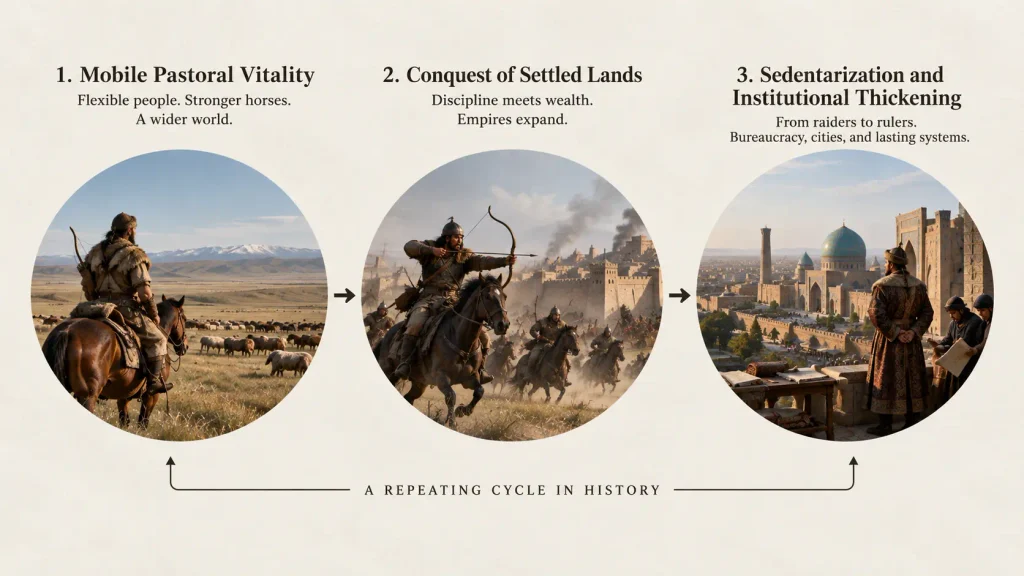
The Mongol case is the clearest large-scale illustration. Genghis Khan’s confederation achieved extraordinary military reach through mobility, merit-based promotion within the army, and ruthless internal discipline. The empire that followed became one of the largest the world has seen. Yet the successor states progressively sedentarized, adopted local administrative forms, and lost the operational edge that had created them. Similar trajectories appear with earlier Iranian-speaking groups, various Turkic confederations, and other steppe-derived polities.
The pattern does not claim that every steppe society remained permanently superior, nor that settled societies never innovated. It claims that the competitive edge of the steppe type was real, recurrent, and self-limiting once settlement occurred.
Counterarguments and Limits
One serious objection is that the “steppe advantage” is overstated and that many expansions succeeded mainly through disease, climate stress, or internal collapse of the settled societies. There is truth here. The late Bronze Age and various later periods show simultaneous pressures. Mobility alone does not explain every outcome. The claim is comparative, not absolute: under conditions where mobility and cohesion could be brought to bear, the steppe organizational form repeatedly proved superior to denser hierarchical alternatives.
A second objection concerns Gimbutas. Her portrait of peaceful, goddess-centered Old Europe versus patriarchal invaders has been criticized as overly schematic. Later work has complicated the picture of both the farming societies and the incoming groups. The genetic replacement data remains robust in several regions; the full cultural inversion she described does not. The article therefore relies on the mobility, linguistic, and demographic evidence more than on the strongest version of her cultural narrative.
A third objection is that successful steppe confederations were themselves hierarchical and often extremely violent toward the defeated. Correct. Low institutional rigidity relative to contemporary empires does not mean egalitarianism or moral superiority. It means fewer fixed administrative layers and faster decision cycles. The violence is part of the record, not an embarrassment to be softened.
Finally, not every mobile society fits the pattern equally, and not every settled society was equally rigid. The framework identifies a recurring competitive logic, not a universal law.
Broader Implications
The steppe pattern is one instance of a wider phenomenon: organizational forms optimized for mobility and rapid cohesion can outperform denser, more extractive systems until they themselves become dense and extractive. The advantage is conditional and temporary. Once the mobile group captures the surplus and the institutions of the settled world, the selection pressures change. The same traits that produced conquest become liabilities or simply fade.
History supplies repeated examples. It does not supply a timetable. The same vulnerability appears whenever institutional rigidity rises and adaptive speed falls, a dynamic tracked across civilizational decline How Societies Collapse
This does not generate precise forecasts. It does identify a structural vulnerability in highly institutionalized societies: when internal rigidity rises and exit options fall, external systems that retain higher adaptive speed gain relative power. History supplies repeated examples. It does not supply a timetable.
Takeaways
- Steppe societies operated as a distinct civilizational type defined by high mobility, high cohesion, and comparatively low institutional rigidity.
- That combination repeatedly outcompeted denser, more hierarchical agricultural systems under conditions that rewarded speed and solidarity.
- The advantage was systemic, not merely technological or racial.
- The same type tended to lose its edge after conquest and sedentarization, as institutional density increased.
- Romantic and purely destructive framings both obscure the competitive logic. Treat the steppes as a recurring organizational solution with clear strengths and clear self-limiting dynamics.
The historical record does not show that civilization is inherently superior. It shows that different organizational forms win under different constraints — and that the winners often become the next rigid system waiting to be challenged.
Attribution
This analysis draws inspiration from Professor Jiang Xueqin’s lecture “Secret History #14: Legacy of the Steppes.” The structure, comparisons, and conclusions are original to Simple Predictive.
Watch the original lecture: https://www.youtube.com/watch?v=JpTI2gFYWrU