

Probably not.
Markets pinned Thursday’s crash on a Democratic win, but the priorities the House Democratic leader has named don’t include data centers, and AI stocks were already shaky over something less political: the cost of borrowing to build all this.
History says booms like this end when the money dries up, not when Washington frowns. Nvidia reports on Nov 17, and i am 80% sure on it beating Wall Street’s revenue estimate.
Tidy story, messy market
Election Tuesday, crash Thursday, case closed. Markets love a story like that.
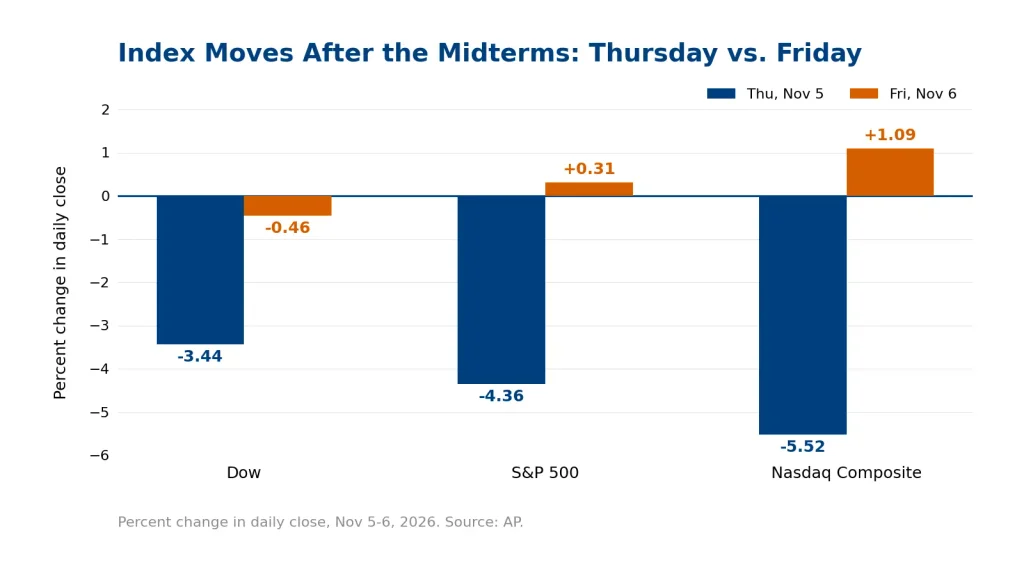
Here’s the damage. On Thursday, Nov 5, the Dow fell 1,833 points, or 3.4%, and the Nasdaq dropped 5.5%, leaving it 11.9% below its record close from last month, AP reported. The S&P 500 fell 4.36% to 7,353.73, its worst day since April 2025. Chip stocks bounced on Friday and the Nasdaq rose 1.1%, but the S&P 500 still finished the week lower, AP reported.
Schwab’s explanation was fear that a Democratic Congress could regulate data centers more strictly, plus likely some profit-taking.
That’s an analyst’s interpretation, not a measured cause, and the same goes for mine. Markets don’t file explanations.But look at what else is on the table. AP noted that AI data-center stocks had been swinging for months on worries that expensive borrowing could slow construction. So the wobble was there before anyone voted.
Friday’s jobs report showed 165,000 new jobs against about 65,000 expected, pushing odds of a December Fed rate hike to roughly 77%, per CME
FedWatchThe 10-year Treasury yield was about 4.86%, below its October intraday peak above 5.30%; the pressure was showing up more in short-term rates and credit than in long-term yields. And Jeffries’s letter says Democrats will focus on five things: reversing Medicaid cuts, restoring SNAP funding, extending ACA tax credits, ending the Trump tariffs, and stopping the war in Iran.
‘Data centers aren’t on the list.’
That doesn’t make Democrats friendly to data centers. Many ran against them, including Texas Gov.-elect Gina Hinojosa, who has called for a pause on new data-center projects.
So the market sold off AI over a regulation that isn’t on Jeffries’s list, from a Congress that isn’t sworn in until January, and any bill would still need Trump’s signature. Maybe traders know something the rest of us don’t. I’d bet they were just looking for a reason.
The 2000 playbook
The last time a technology build-out got this far ahead of its paying customers was telecom. The Nasdaq fell about 78% between March 2000 and October 2002, from a peak close of 5,048.62 to 1,114.11. That’s two and a half years. No single Thursday did it.
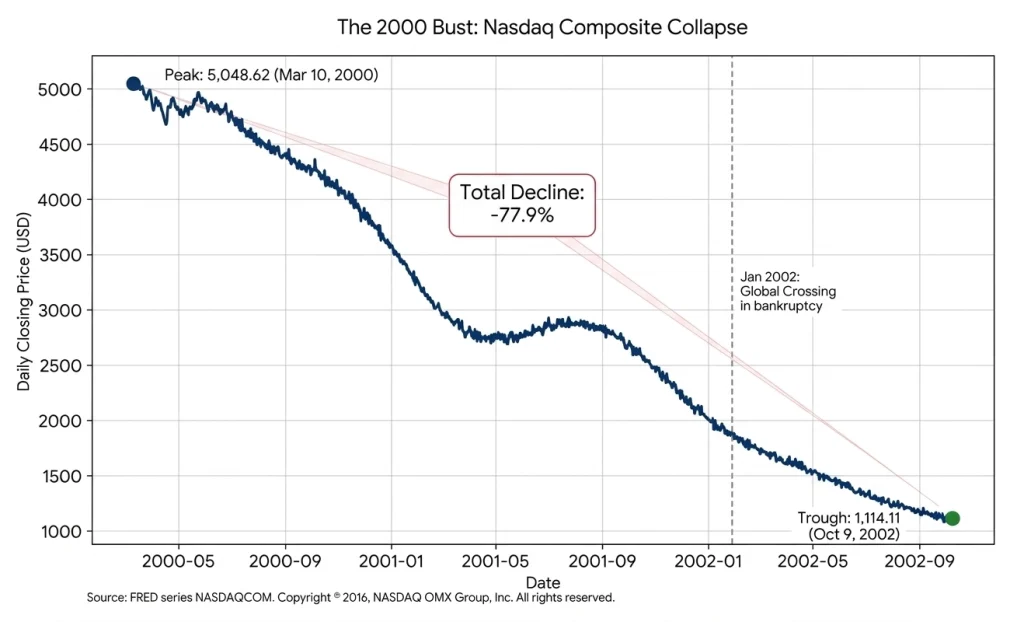
What matters is who actually died, and how. Global Crossing, which had borrowed heavily to build fiber networks, was in bankruptcy by January 2002. WorldCom followed with an $11 billion accounting fraud. These weren’t companies undone by a new rulebook. They were builders who bet that demand would catch up to the cables, and ran out of lenders before it did.
And regulation?
It was the starter pistol, not the killer. The Telecommunications Act of 1996 opened the industry to competition and helped set the whole boom running. The rules gave the boom permission to start. Credit decided when it ended.
Here’s my read, and I’ll commit to it.
A boom financed with borrowed money is fine right up until lenders get nervous, and then it’s very much not fine. That’s the version of the story with a track record. A regulation scare can knock a stock down for a week. A financing scare can take a whole industry’s builders with it.
What Nov 17 will and won’t tell you
Nvidia’s third-quarter call is Tuesday, Nov 17, and the quarter it covers ended Oct 25. That was more than a week before the election, so neither the vote nor Thursday’s crash is in the number. The revenue figure is a look backward at orders placed before any of this.
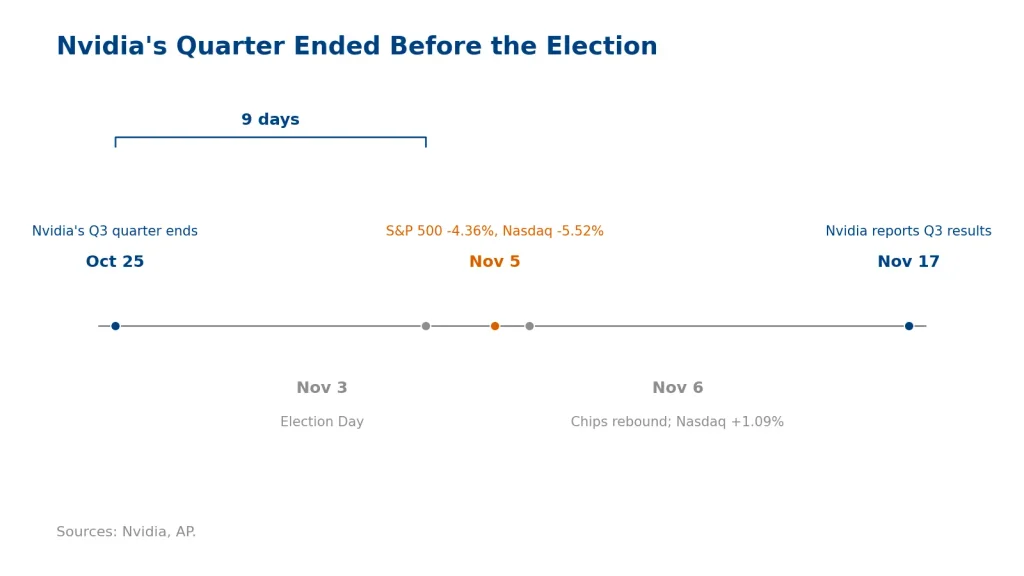
That’s why the headline number matters less than you’d think. If financing is the real weak spot, it shows up when Nvidia’s customers, the companies building the data centers, slow their orders. You’d see that in what Nvidia says about the next quarter and in how its customers talk about paying for their builds, not in the quarter that just closed. A beat won’t tell you the boom is safe. It’ll tell you the boom was fine through October.
I wrote about the local data-center ballot fights in an earlier post. Tuesday’s results are the part of this story that actually is about regulation: voters backed limits in 40 of 41 local measures, per Ballotpedia. They’re also local, which is a long way from a national crackdown.
The Prediction
Nvidia will report Q3 FY2027 revenue above the Wall Street consensus, using the FactSet consensus as of Nov 16.
Nvidia’s press release on Nov 17, 2026 settles it.
I give this a 80% chance of happening and will check the final score that day.