The conventional story of civilization is almost exactly backwards.
We are told that hungry hunter-gatherers discovered farming, produced a surplus, freed an elite from labor, and that this elite then invented religion, art, science, writing, and law. Hierarchy came first; meaning followed as its servant. The evidence from the earliest urban societies does not support this sequence.
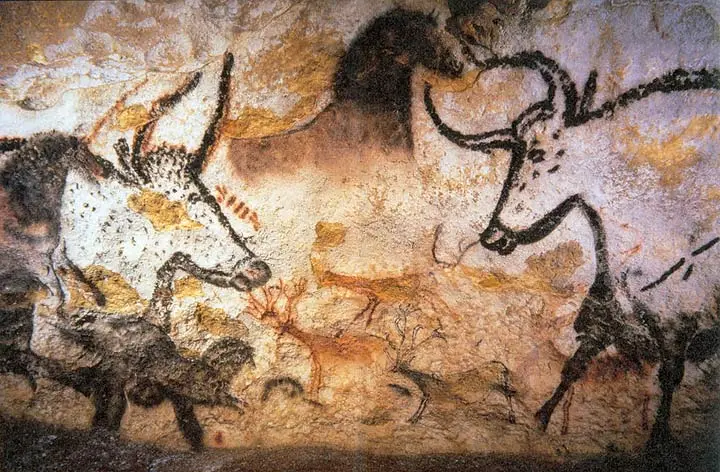
Humans were already religious, artistic, and capable of complex technical knowledge long before the first cities. Cave paintings, monumental temples such as Göbekli Tepe, and early ritual settlements demonstrate the point. What changed was not the sudden appearance of imagination. What changed was the capture of that imagination by a new institutional form.
That institutional form is what later ages would call the Mandate of Heaven.
The Materialist Origin aMyth
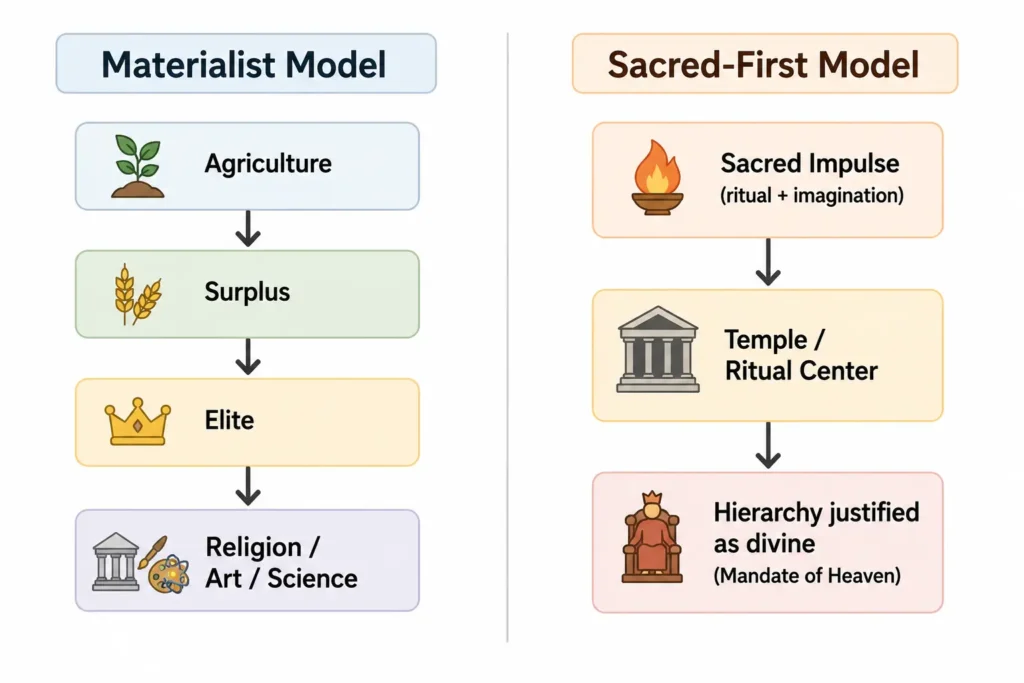
The dominant academic account, still shaped by Marxist categories, runs as follows. Life as a hunter-gatherer was precarious. Agriculture created surplus food. Surplus allowed some people to stop farming. These non-producers developed religion (stories that justified their position), art, science, and eventually writing and money. Cities, irrigation, hereditary elites, and formal property rights followed. Civilization is therefore the package that results from material surplus.
The package also produces its shadow side: organized war, slavery, and debt.
This framework is elegant and widely taught. It has one decisive weakness. It assumes that ordinary people lacked the capacity for religion, art, or science until an elite liberated them from daily labor. The archaeological record does not cooperate. Ritual architecture and sophisticated symbolic systems appear before large-scale agriculture and long before hereditary priest-kings.
The Alternative Sequence
An alternative reading fits the evidence more cleanly.
From the beginning, humans gathered around shared religious and artistic practices. Temples and ritual centers formed first. Farming expanded to feed the people who maintained those centers. Over time, the temple became a redistribution point a primitive tax and welfare system. Food, labor, and goods flowed through the temple, and records became necessary. Writing emerged as an administrative tool. Trade intensified because temples sat at natural meeting places.
As the temple economy grew, a hereditary elite consolidated control. People could still leave and found new temples elsewhere. To keep them in place, the elite needed a stronger claim than convenience or force. They needed a story that made the hierarchy appear natural and divine.
That story is the Mandate of Heaven in its earliest form: the claim that the existing order is not a human arrangement but a cosmic one. The gods themselves require the hierarchy. Kings and priests are merely their agents. To reject the social order is to reject the gods.
Civilization, on this reading, is less the flowering of human potential than a technology for making hierarchy feel inevitable.
The Four Early Civilizations
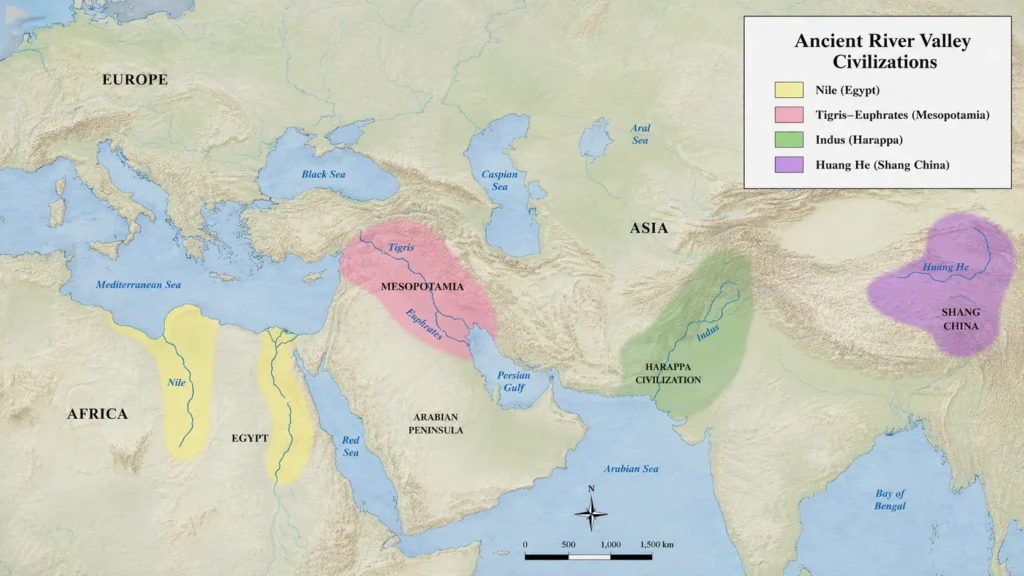
The earliest major urban societies — Egypt along the Nile, Mesopotamia between the Tigris and Euphrates, the Indus Valley (Harappan) civilization, and early China along the Yellow River — share three structural features. They sit in similar latitudes favorable to agriculture. They are anchored to major rivers that solve water and transport problems. And they have access to the sea, which multiplies trade.
Trade is decisive. A temple that becomes a commercial crossroads acquires real estate value that is difficult to abandon. People stay. The city grows. Colonies form upstream and downstream. The temple economy expands into a civilizational system.
China is geographically more isolated by the Himalayas and therefore develops along a somewhat different trajectory. The other three form the connected core that later traditions would call the foundation of Western civilization — a term that is geographically and historically misleading if it is restricted to Europe.
Mythology as Operating System
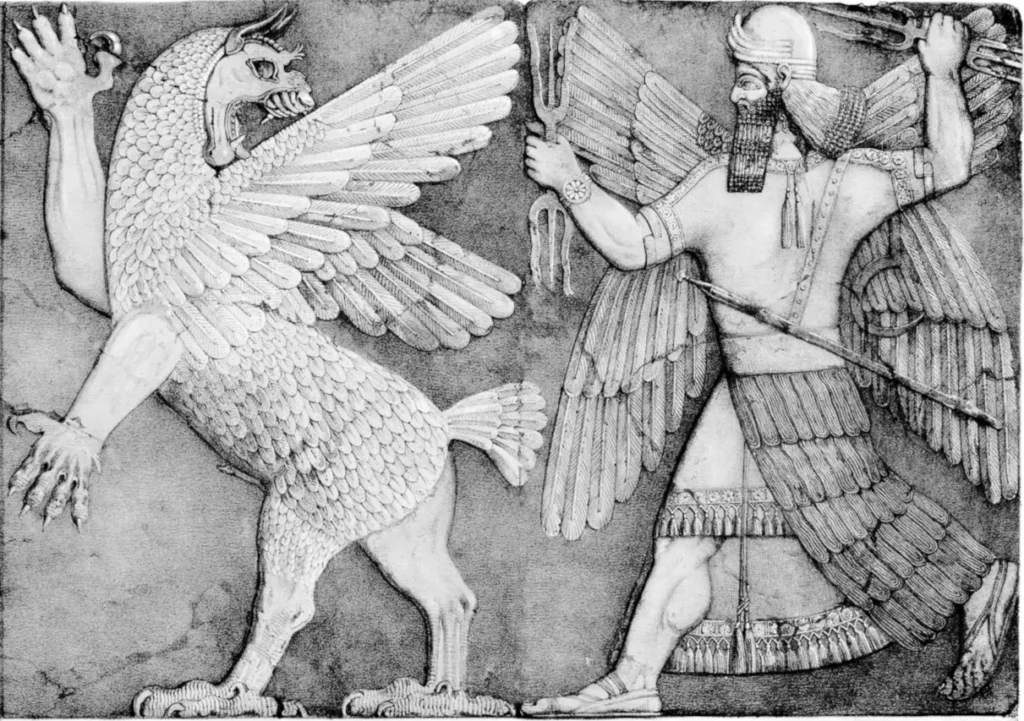
The clearest early evidence for the Mandate mechanism appears in Mesopotamia.
The Enuma Elish, the Babylonian creation epic, presents a world in which the sky god Marduk defeats older forces and organizes the cosmos. Humans are created to serve the gods by building and maintaining the city of Babylon. The city itself is described as a divine project. Hierarchy is not a human invention; it is the structure of reality.
This is not neutral storytelling. Comparative mythology shows a repeated pattern of inversion. Earlier, more egalitarian or mother-goddess oriented traditions are rewritten so that a male sky god becomes supreme and demands toil, order, and obedience. The older sacred landscape is not erased; it is subordinated and reinterpreted.
The Epic of Gilgamesh performs a related function. An older legendary figure is reshaped into a king who learns that personal immortality is impossible and that lasting renown comes through service to the city and its people. Kingship is legitimized as the proper human response to mortality and cosmic order.
Writing is essential to the process. Once the myths are fixed in permanent form, they can be taught as the official account of reality. Bureaucratic records and sacred texts reinforce each other. The temple economy requires accounting; the accounting system requires a cosmology that makes the temple’s authority non-negotiable.
Hesiod’s Theogony and the Sumerian “Debate between Sheep and Grain” belong to the same family of texts: they organize the world into ranked categories and assign human labor a place inside a divine hierarchy.
Mechanism
The Mandate of Heaven is best understood as a coordination technology with two faces.
On one face it enables large-scale cooperation. Shared belief in a cosmic order allows people who do not know one another to accept common rules, contribute surplus, and maintain irrigation, temples, and trade networks. Without some version of this shared story, the transaction costs of city life would be prohibitive.Without some version of this shared story, the transaction costs of city life would be prohibitive.
This is the same coordination problem that appears, in different institutional form, in the opening framework of how power actually operates (How Power Works).
On the other face it locks people into place. Once the hierarchy is declared divine, exit becomes not only economically costly but cosmically dangerous. Dissent is no longer a practical disagreement; it is rebellion against the structure of the universe.
This dual character explains both the durability and the fragility of early states. The same story that builds the system also creates a legitimacy standard that rulers can fail. When harvests fail, when elites become visibly extractive, or when rival temples offer a competing cosmology, the Mandate can be withdrawn. The Chinese tradition later formalized this logic, but the underlying mechanism is already visible in the Mesopotamian and Egyptian material.
Counterarguments and Limits
An intelligent critic might reply that every complex society needs some shared narrative, and that calling the narrative “gaslighting” is anachronistic moralizing. There is force to the point. Coordination requires stories. The question is whether the stories accurately describe the relationship between rulers and ruled, or whether they systematically obscure it.
The evidence that early mythologies were rewritten to invert older, less hierarchical traditions suggests the latter. The repeated elevation of sky gods who demand struggle and the corresponding demotion of earlier earth- and fertility-centered cults is difficult to explain as pure organic evolution. It looks more like institutional capture of the sacred.
Another critic might note that China developed an explicit Mandate of Heaven doctrine much later and with distinctive features (virtue of the ruler, right of rebellion). That is true. The claim here is not that every civilization used identical language. The claim is that the functional problem — how to make hierarchy feel non-optional — produced analogous solutions across the earliest urban systems.
Finally, the alternative sequence does not deny the material conditions of rivers, climate, and trade. It denies that those conditions are sufficient to explain the appearance of religion, art, and science. The imaginative capacities came first; the institutional capture came later.
Broader Pattern
The same mechanism recurs whenever a new scale of organization requires people to accept constraints they would otherwise reject. Later empires, churches, and modern states have all produced updated versions of the Mandate: the claim that the existing order is not merely useful but cosmically or historically necessary.
Later empires, churches, and modern states have all produced updated versions of the Mandate: the claim that the existing order is not merely useful but cosmically or historically necessary.
The same legitimacy vulnerability reappears whenever that claim weakens, a recurring pattern tracked across civilizational decline (How Societies Collapse).
When the claim is widely believed, cooperation is cheap and exit is rare. When the claim weakens — through visible corruption, competing narratives, or material failure — the system enters a legitimacy crisis. The pattern does not predict specific dates. It identifies a recurring vulnerability: any order that rests on a divine or quasi-divine story is only as stable as belief in that story.
Takeaways
- Religion, art, and science are not the products of civilization. They precede it.
- The earliest cities grew around temples and redistribution systems, not around surplus created by private farmers.
- Hierarchy required a divine justification to become sticky. That justification is the functional core of the Mandate of Heaven.
- Mythology in the early urban period is best read as political technology, not as innocent cosmology.
- The same mechanism that enables large-scale order also embeds the conditions for legitimacy collapse when rulers fail the story they themselves promoted.
The sacred imagination was never invented by elites. It was recruited by them. Understanding the difference is the first step toward seeing how power has operated from the beginning of recorded history.
Attribution
This analysis draws inspiration from Professor Jiang Xueqin’s lecture “Secret History #13: Mandate of Heaven.” The structure, comparisons, and conclusions are original to Simple Predictive.
Watch the original lecture: https://www.youtube.com/watch?v=FJF8oD_5c_w