
Source: U.S. Department of Defense (CENTCOM) / Associated Press (AP) / Reuters
See the prediction scoreboard →
Probably, YES.
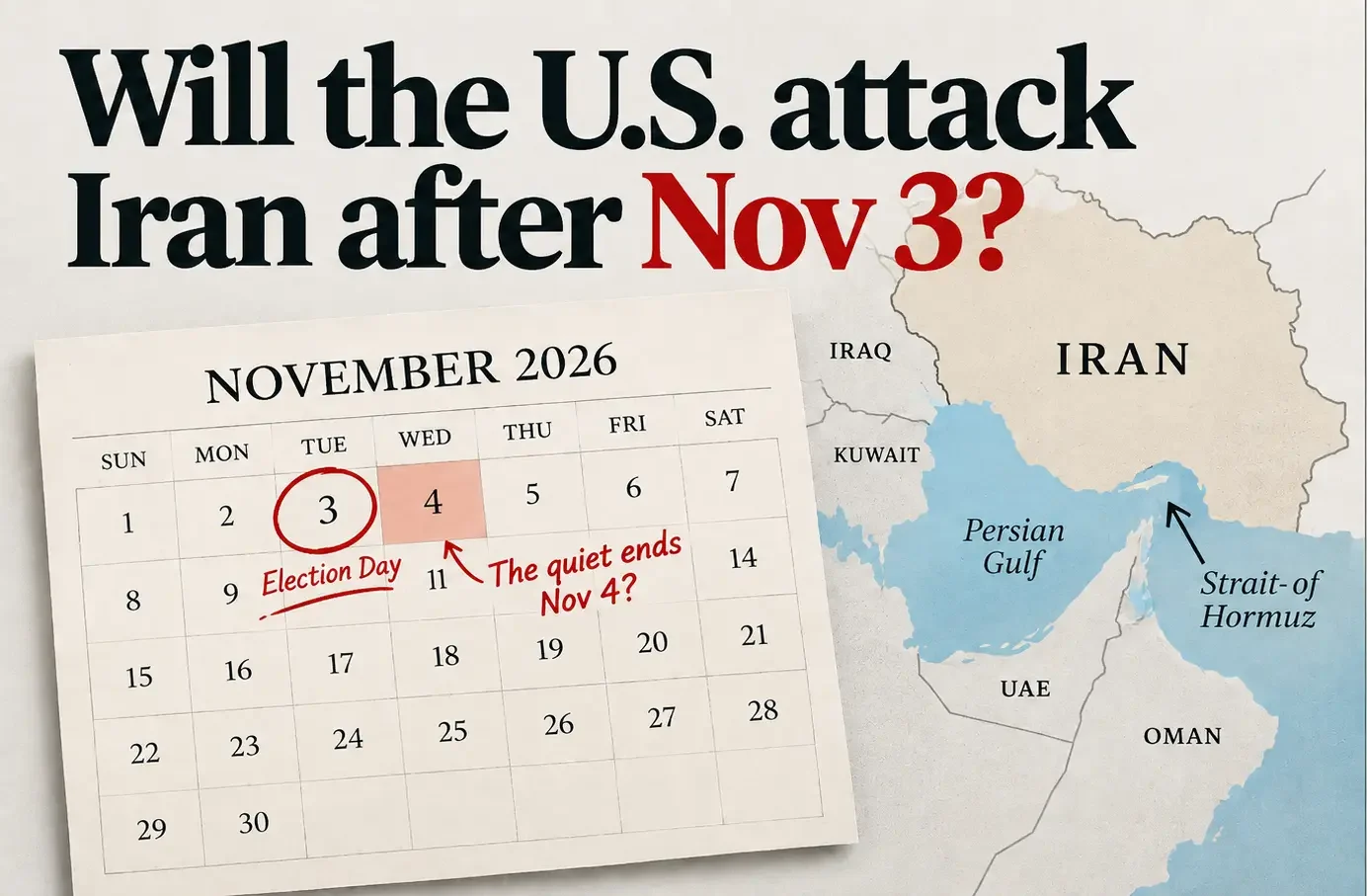
On Oct 8, Trump said he won’t order strikes before Nov 3, and he did not say the same about Nov 4. History says that when a president goes quiet before an election, the big decisions don’t vanish. They get scheduled for the week after.
I’m predicting 60% on at least one US strike inside Iran between Nov 4 and Dec 31.
The Nov. 4 problem
First, what we’re actually talking about. The US launched its first attacks on Iran on Feb 28. By late July, CENTCOM said it had hit Iranian targets for a 13th straight night. This isn’t a country deciding whether to start a war. It’s a war on pause.
The pause has a stated end date. AP reported that Trump said Oct 8 he won’t order strikes before Nov 3, citing “productive discussions.” Those talks had been at a standstill since he rejected Iran’s offer to reopen the Strait of Hormuz within seven days. Scripps reported he did not rule out an attack after the vote. On his way to a September Republican convention, he told reporters the conflict would end immediately after the elections. Notice what that sentence doesn’t say: how.
Here’s where the leak comes in. The Atlantic reported on Oct 7, citing two administration officials, that the White House asked the Pentagon for options it could use before the election, with planning tied to wanting progress and lower gas prices. The Pentagon also laid out post-election options, from limited strikes to large-scale attacks that could hit Iran’s energy industry. Even supporters concede limited strikes wouldn’t reopen Hormuz or cut gas prices before the vote.
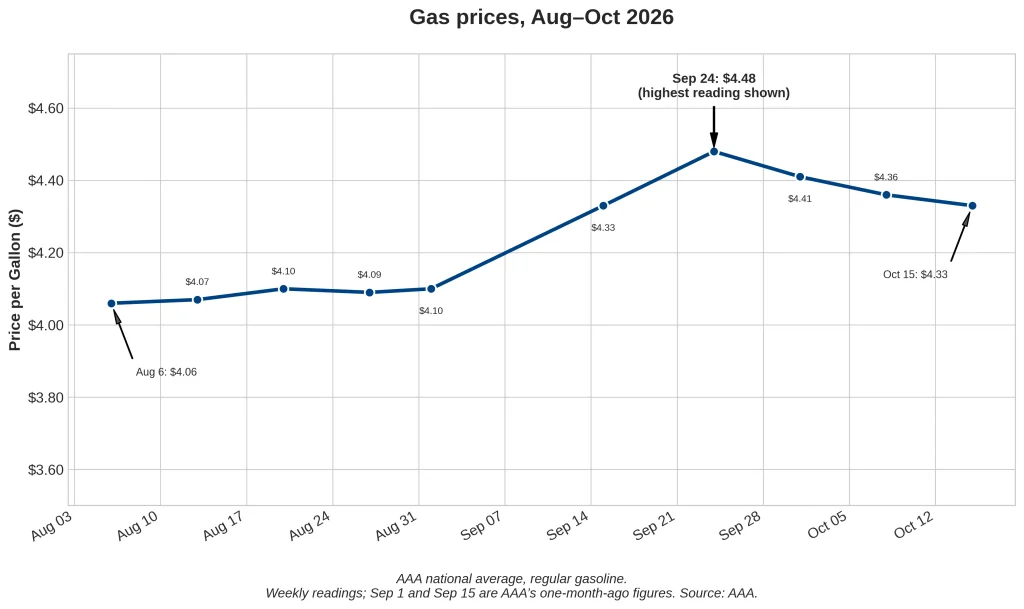
And gas prices are the pressure point. AAA’s national average was $4.33 a gallon as of Oct 15, against $3.07 a year earlier, after a record September average of $4.33. Reuters/Ipsos found on Oct 8 that 30% of 2024 Trump voters were very enthusiastic about voting, against 48% of 2024 Harris voters. That’s the backdrop for a quiet October.
I expected the strike-options leak to be the story. It isn’t. The calendar is.
Three elections, one pattern
1968. On Oct 31, five days before the election, Lyndon Johnson ordered a complete halt to the bombing of North Vietnam, with the first talks set for Nov 6, the day after the vote. South Vietnam’s President Thieu then rejected the initiative. A move that landed five days before the vote turned out to be fragile once the vote passed. (Historians still argue over who got to Thieu and why, so I’ll leave that fight alone.)
1972. On Oct 26, Henry Kissinger told a news conference that “peace is at hand.” Nixon won on Nov 7. The war went on, and in December came the Christmas bombing of North Vietnam, about six weeks after the vote. Calm before an election and peace are different things.
1990. The midterms were Nov 6. Two days later, George H.W. Bush ordered about 200,000 more troops to the Gulf, bringing the total to about 430,000, to ensure an “offensive military option.” The air war began Jan 17, 1991. The order came after the ballots were counted.
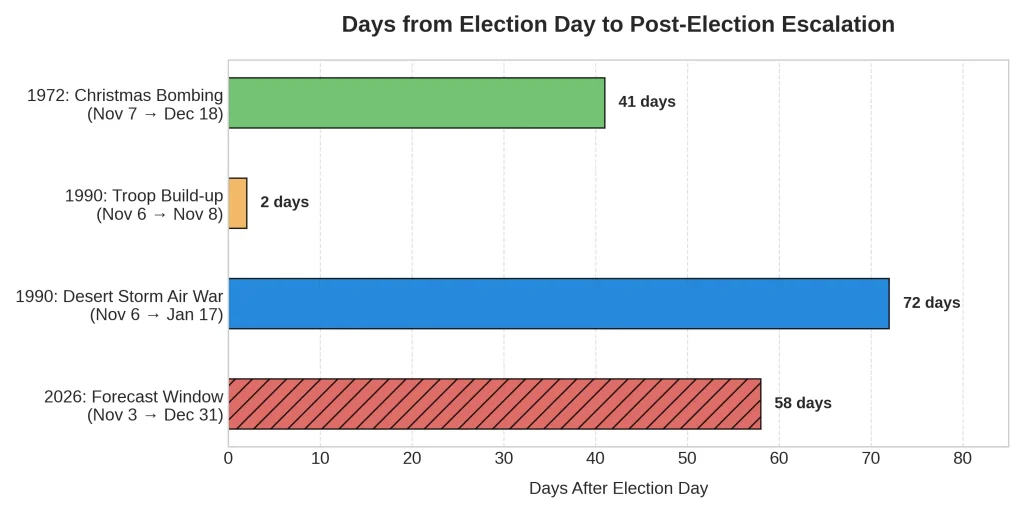
Three different wars, three different presidents, one habit: restraint while voters are watching, bigger decisions once they’re done. In the Gulf, escalation was announced two days after the election and fighting started ten weeks after that, a bit past the window we’re betting on. In 1972 it took six weeks, well inside it.
Where this breaks
The strike-planning story rests on two unnamed officials, and drawing up options is not an order to execute them. So my call doesn’t lean on the leak. It leans on this year’s pattern of repeated strike waves and on Trump’s own post-election framing.
The Prediction
The US will conduct at least one military strike on targets inside Iranian territory between Nov 4 and Dec 31, 2026. It counts if US officials at CENTCOM, the Pentagon or the White House acknowledge it, or if Reuters or AP report it.
Tanker seizures, at-sea interdictions, defensive intercepts and Israeli-only strikes don’t count.
It resolves Dec 31, 2026.
I’d put it at about 60%, and I’ll score it on the scoreboard that day.