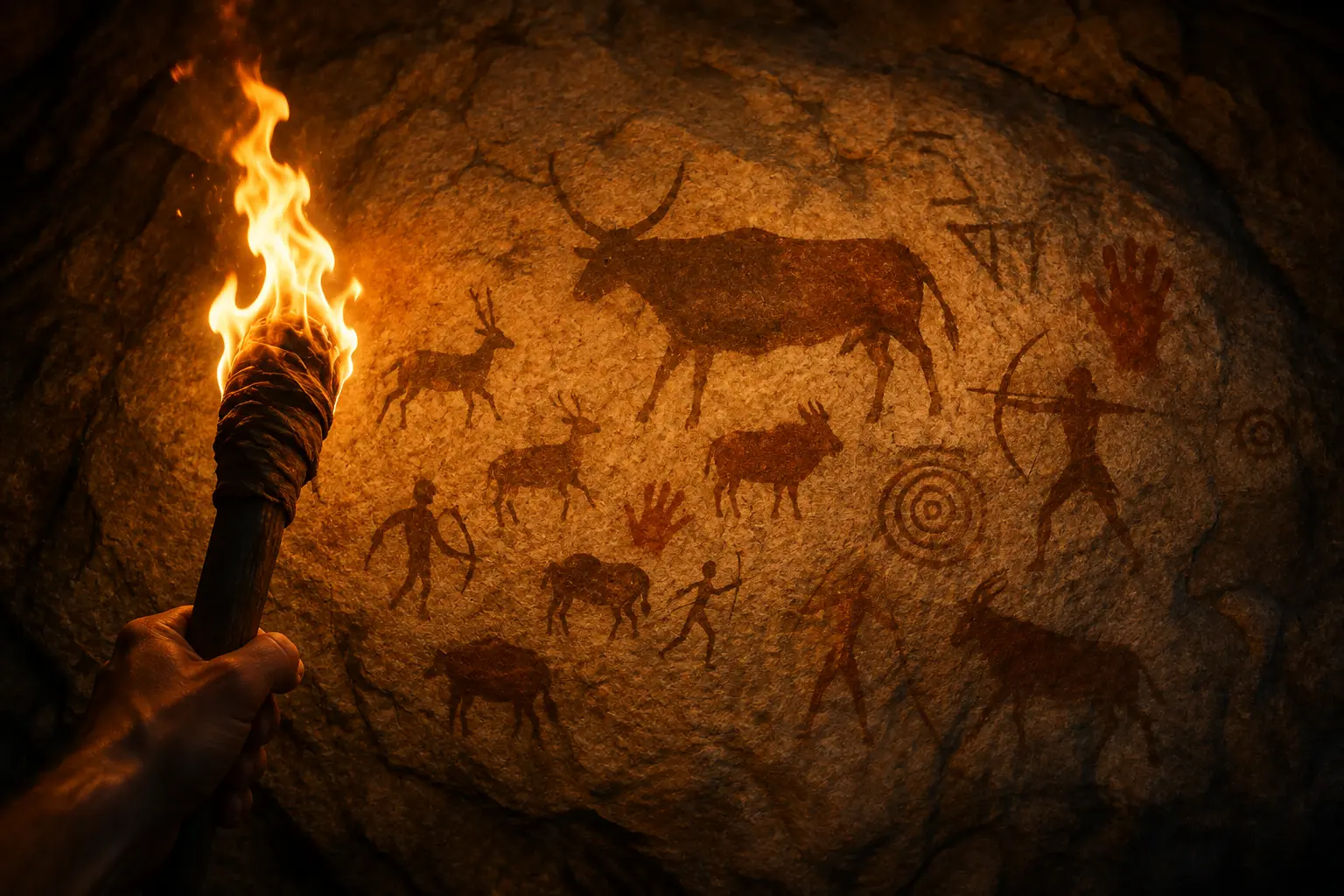
Most accounts of human origins tell a survival story. Bigger brains. Better tools. Better hunting. These things happened. They are not the real break.
Something far stranger appeared. Early humans began treating the invisible as real. They buried their dead with care. They painted in dangerous, pitch-black caves. They performed rituals that had no practical benefit.
This is the dawn of the human imagination. It is the moment we stopped being only clever animals and became something else. Modern stories have quietly reduced its importance.
What the Dawn of the Human Imagination Actually Means
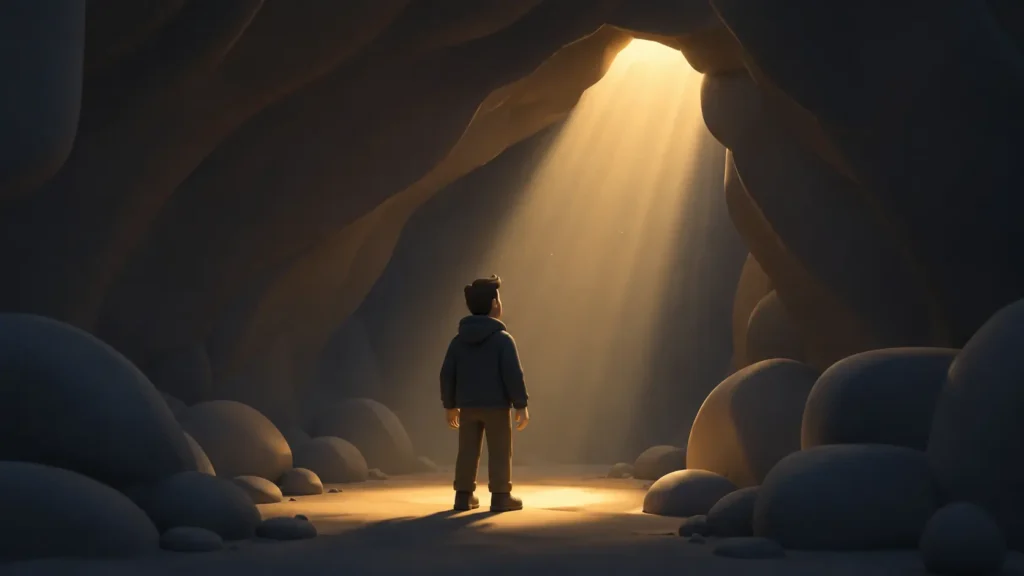
The dawn of the human imagination is the point when humans began living in two worlds at once.
One world was physical: food, danger, cold, reproduction.
The other was symbolic: meaning, ancestors, spirits, stories, and forces that could not be touched.
This second world changed behavior. People started spending scarce time and energy on actions that did not help them survive the next week. They created art, burial rites, and shared beliefs that only make sense if the unseen matters.
That capacity—to treat what cannot be seen as important and binding—is the true human difference. Not just higher intelligence. The ability to imagine and then live by what was imagined.
The difference is easy to overlook because we take it for granted. Every time a person feels that a place is sacred, that an action carries weight beyond its practical result, or that the dead still matter, they are using the same capacity that first appeared tens of thousands of years ago. The dawn of the human imagination is not only a distant event. It is the origin of a way of being that still operates in us.
The Central Mechanism: Symbolic Thinking
The decisive mechanism was symbolic thinking.
A tool solves a physical problem.
A symbol creates a shared reality that does not exist in the physical world alone.
Once this capacity stabilized, new possibilities opened fast.
Groups could be bound by common stories instead of only kinship.
Death could be given meaning beyond the body.
Obligations could extend to the dead and to the unborn.
People could feel purpose, awe, and duty that went far beyond immediate needs.
Tools extend the body.
Imagination reorganizes the mind and the social world at the same time.
This is why the dawn of the human imagination outweighs any single technological invention. It created a new kind of being—one that could be moved by things that were not physically present. That new being could cooperate at larger scales, sustain motivation under hardship, and create obligations that pure self-interest could not generate. The capacity itself became a source of power.
The Broader Pattern
Once symbolic thinking took hold, several lasting patterns appeared.
Humans became capable of large-scale cooperation based on shared fiction. Stories about ancestors, spirits, or cosmic order could coordinate behavior across groups that had never met. This was a major advantage.
Death stopped being only a biological event. It became a social and symbolic event. This changed how groups treated both the living and the dead. It created new forms of continuity across generations.
Meaning itself became a resource. Groups that could generate strong shared meaning gained advantages in cohesion and willingness to sacrifice that pure material incentives could not match.
At the same time, this new capacity created new vulnerabilities. Whoever could shape the shared symbols gained influence over the group. The dawn of the human imagination produced both deeper cooperation and new forms of control. The same force that made large human societies possible also made them more open to narrative power.
Historical Parallels
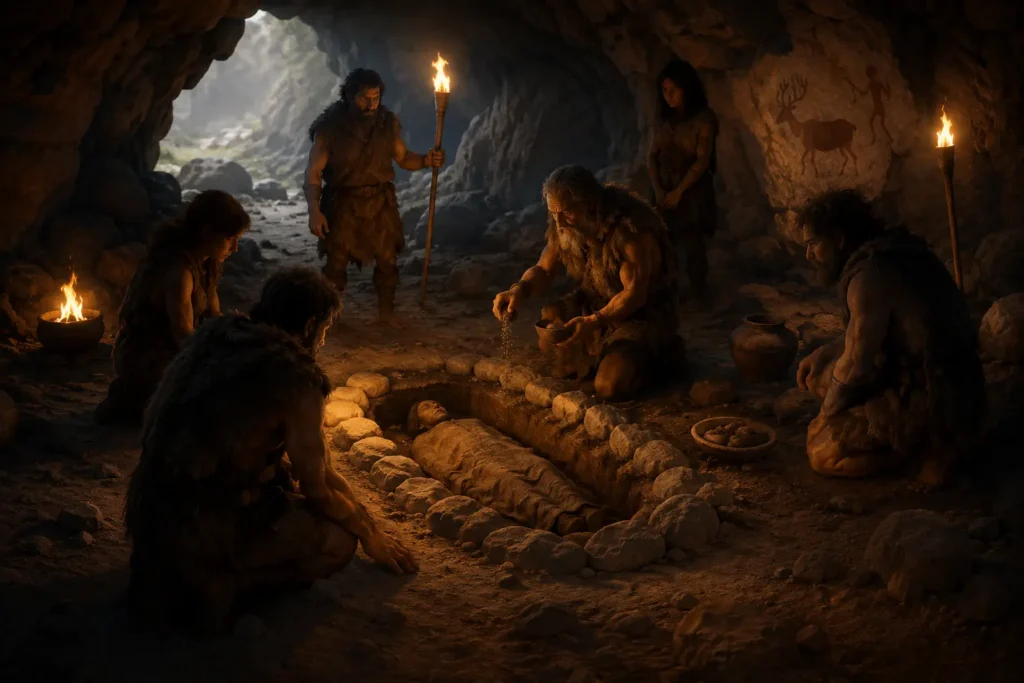
The pattern is visible in the earliest evidence we have.
In multiple regions, deep cave paintings appear tens of thousands of years ago. Sites such as Chauvet in France, Lascaux, and others in Indonesia show sophisticated images placed far from living areas, often in chambers that required effort and courage to reach. The locations themselves suggest that the act of painting was not practical decoration. It was connected to ritual, vision, or encounter with something beyond ordinary life. The technical skill and the chosen locations together point to a developed symbolic life. These were not casual markings. They were deliberate acts carried out in places that demanded commitment.
Deliberate burial practices emerge in the same broad period. Bodies are arranged with care. Objects, tools, and pigments such as ochre are placed with the dead. In some cases the positioning of the body implies beliefs about continued presence or another state after death. These are not the actions of creatures concerned only with hygiene or disposal. They are the actions of beings who treated death as meaningful and who believed the dead still stood in some relation to the living. The consistency of these practices across different regions suggests a shared underlying capacity rather than isolated local habits.
Care for injured and elderly individuals appears alongside these symbolic behaviors. Remains show people who lived for years with serious injuries or impairments that would have required support from the group. When this care is combined with art and ritual, it points to empathy and obligation that go beyond immediate usefulness or simple genetic calculation. Together, the paintings, the burials, and the evidence of care form a coherent picture: early humans were already living inside a symbolic world that shaped their actions as strongly as the physical world did.
These developments occur long before cities, writing, or organized states. The capacity for imagination and symbolic life was already present in full force. Later civilizations built elaborate religions, political myths, and artistic traditions on top of it. They did not invent the core ability. The dawn of the human imagination is older than the institutions that later tried to manage, formalize, or restrict it.
Why the Standard Story Downplays This
The dominant modern story prefers a thinner human: a clever animal shaped mainly by survival pressures and reproductive success.
This version is convenient. It fits cleanly into a material framework. It treats mind as secondary and meaning as a late side-effect of brain activity. It also makes humans easier to model and easier to manage through incentives, status, and control.
A full recognition of the dawn of the human imagination is more disruptive. It means the need for meaning, ritual, and relation to the unseen is not a cultural extra that can be safely ignored or reduced to private preference. It is foundational. Any system that starves, trivializes, or over-manages this dimension creates a form of human damage that is easy to overlook because it does not appear clearly in economic or biological metrics.
So the standard story emphasizes tools, hunting efficiency, and brain size. It notes cave art and burial, then moves on. It registers the dawn of the human imagination and then reduces its weight. The public picture of early humans becomes narrower than the evidence supports. This narrowing is not the result of a single conspiracy. It follows from the incentives of an intellectual culture that prefers material explanations and measurable variables. The cost is a diminished understanding of what the species actually was—and still is.
The Path Toward Narrowed Imagination
Later systems of power did not erase the capacity. They redirected and limited it.
Organized religions formalized it into doctrines, hierarchies, and approved rituals. The open-ended encounter with the unseen became more regulated and mediated.
States used symbolic power for legitimacy, turning myths, ceremonies, and collective stories into instruments of rule.
Markets learned to convert parts of the imaginative capacity into entertainment, branding, and consumption.
Modern education and media often reduce it further—to private fantasy, professional creativity, or psychological coping.
The original force—the ability to stand before the unknown and treat it as real and binding—became more managed at each stage. In many contemporary settings it is treated as optional, subjective, or potentially disruptive if it escapes approved channels. People are still allowed to imagine. They are discouraged from treating the products of deep imagination as serious claims on shared reality.
Humans still carry the capacity that appeared at the dawn of the human imagination. Many now live in environments that give it fewer serious public outlets. The hunger for meaning does not disappear. It is redirected into narrower forms: career, consumption, ideology, or private spirituality that is not permitted to challenge the official order. The capacity remains. The permission structure around it has tightened. This creates a quiet but widespread sense of incompleteness even in conditions of material abundance.
Connecting the Threads
This early break connects directly to the larger patterns of power already examined.
Control over the foundational story of reality, examined in the theory of everything, shapes what people believe human beings are.A story that minimizes the dawn of the human imagination makes it easier to treat people as mainly biological and economic units. Once that thinner picture is accepted, many later forms of management appear natural rather than imposed.
Narrative control works more smoothly when the deeper need for meaning is pushed into safe, managed forms. Closed systems of power have always had an interest in shaping what imagination is allowed to take seriously. The same institutions that protect official stories about major events also influence the background assumptions about what kinds of meaning are legitimate.
Modern selection systems and bureaucracy reward measurable performance and procedural correctness. They give little formal value to older capacities: ritual sense, symbolic depth, and insight that cannot be easily tested or certified. The human produced by these systems is often highly skilled, highly evaluated, and internally narrower than the beings who once painted in the dark and buried their dead with care. Meritocratic and administrative environments select for traits that fit their metrics. They have limited room for the older, less measurable dimensions of the human that first appeared at the dawn of the human imagination.
Seeing the origin point clearly makes the later management easier to recognize. The force that made us human is the same force that later systems have continuously tried to channel and contain. When the foundational capacity is undervalued, the systems built on top of it can more easily present themselves as complete.Understanding how real power works requires seeing how the original human capacity for imagination has been managed across time. The thinner the official picture of the human, the more natural the later forms of control appear.
Practical Observations
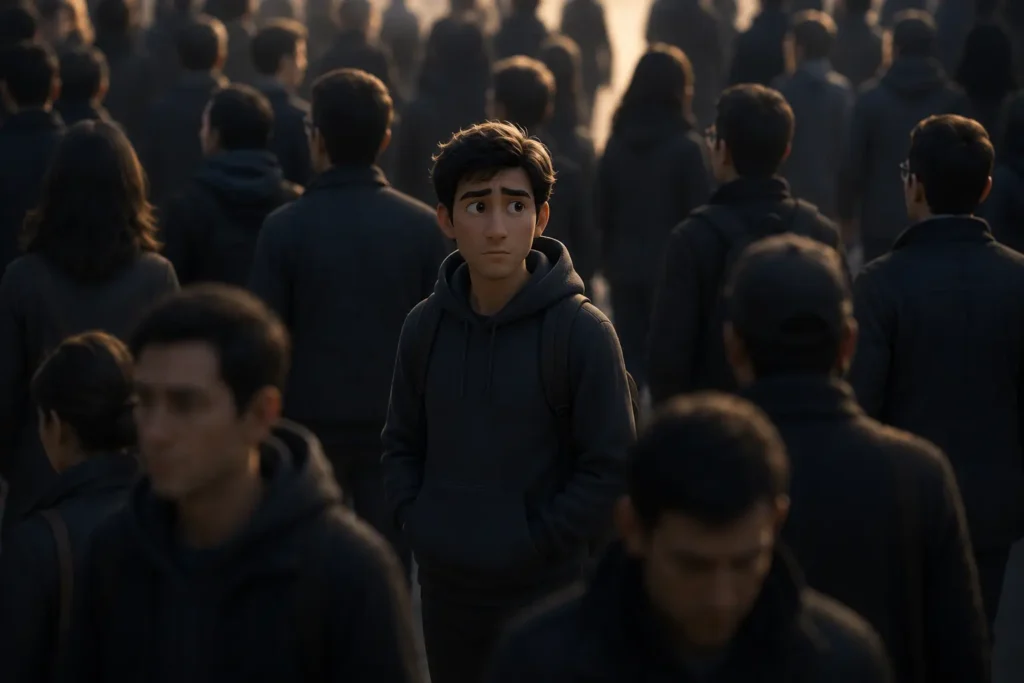
Clear signals that a society has narrowed this original capacity:
- Meaning and ritual are treated as private or optional rather than central to shared life
- Education focuses almost entirely on measurable skills and approved knowledge
- Experiences of awe, deep grief, or the unseen have few serious public forms
- Art and story are valued mainly as entertainment, therapy, or status
- People report a persistent hunger for meaning that official structures do not meet
- The language of efficiency and function consistently crowds out the language of depth and obligation
Societies that still allow serious symbolic life, unmeasurable insight, and shared encounters with the unknown keep more of the original human range intact. Those that reduce everything to function, performance, and measurable outcomes create a quieter form of emptiness that is easy to misdiagnose as individual psychological failure.
Closing
The dawn of the human imagination was not a minor upgrade in intelligence. It was the appearance of a new kind of being—one that could live in relation to what it could not see or prove.
That capacity is still present in every human.
It is also heavily managed by the systems that organize modern life.
The modern world runs on a narrower version of the human than the one that first appeared in the caves. Once this is clearly seen, many later systems of power look less like pure progress. They look like long efforts to direct a force that was never only about survival.
The force is still here.
The real question is how much of it is still allowed to act.
This article is an original analysis inspired by Professor Jiang’s lecture Secret History #11: Dawn of the Human Imagination. The structure, explanations, and historical examples are independently written. Original lecture: https://www.youtube.com/watch?v=LvHsg5qtDs8